
Stock Adjustment And Report
What is Stock Adjustment? And how to use it?
Stock Adjustment
Stock Adjustment helps you decrease the goods you hold in stock, you can enter manual stock adjustments. It’s generally used to write off damaged stock or to adjust quantities after a stock take.
To create a stock adjustment
- First, go to “Add Stock Adjustment.”
- Select the Business Location & date
- Select Adjustment Type (Normal Or Abnormal). Normal Or Abnormal is generally used to classify adjustment.
Generally, Normal Adjustment means Adjustment for normal reasons like leakage, etc.
Abnormal meaning: Adjustment for reasons like Fire, Accident, etc. - Add the products & quantity you want to decrease the product.
- Total amount recovered: Sometimes you can recover some amount from the damaged stocks, like from insurance claims, selling of scraps, etc. If there is no amount recovered, then you can simply make it 0. The recovered amount is taken into consideration when making a profit & loss report, it is added to the total profit/loss.
The quantities entered for each product will be deducted from the available quantities.
You can view the details of stock adjustment in the “Stock Adjustment Report.”
Also, Stock Adjustment is used in the Profit & Loss Report (P & L Report). The “Total Stock Adjustment” amount is deducted from (the P & L Report) and the “Total Stock Recovered” amount is added to the Profit & Loss Report.
Reports
Reports help you to get an overview of your entire business.
To view the report, click on Reports & Select the report you want to view.
Some Reports come to filter relevant options to help you analyze your business better.
Purchase & Sale Report
This report shows the total purchase, Purchase Including tax, Purchases with Dues amount; Total Sale, Sale Including tax, and Sale Due.
Tax Reports
Shows the Input & Output Taxes.
Contacts Report(Customers & Suppliers Reports)
This report shows the details of Purchase & Sell with all contacts (Suppliers & Customers) and also any Due amount. A positive due amount indicates payment by contact, and a negative indicates payments to the contact.
Stock Report
The stock report displays the stock details. With this, you can track the remaining stock and total quantity sold for all products.
For variable products – you can click on the Green Plus button before the SKU column to get detailed stock reports for each product variation.
Stock value by Purchase & Sales price
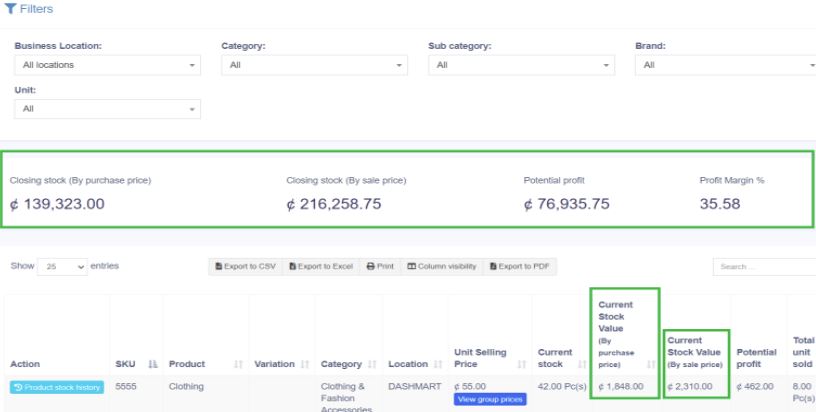
In the stock report, you can also get information about the current stock value based on their purchase price & value based on selling price. Check the below screenshot of the stock report.
Tracking product stock report with date
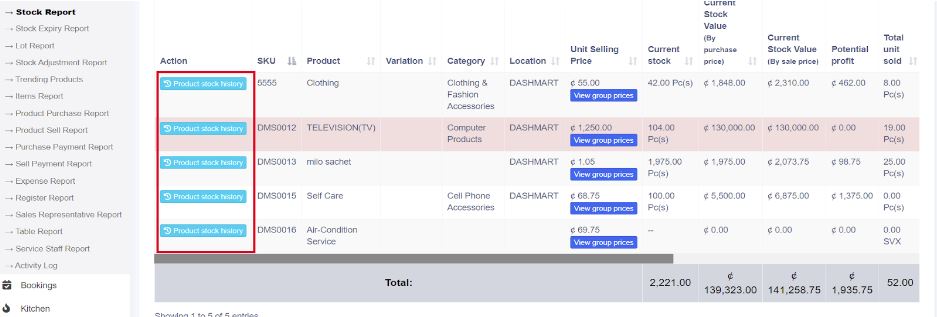
To check the product stock report date-wise, use the ‘product stock history‘ link in the stock report.
Trending Products Report
- This report helps you to determine the demand for the products.
- You can apply different filters to filter the product.
- Select a Business Location to view trends for a particular business location.
- Select Product Category, Sub-Category, Brands, Units, and Date Range to filter them.
- Set “No. of products” to view the top of the amount of product. Using this you can view the Top 5, Top 10, or any number of top products.
Expense Report
The Expense report helps you to analyze expenses for business locations and also analyze them based on expense categories.
Register Report
View details of all registers and filter registers based on User and/or Status (Open or Closed)
Sales Representative Report
- View Sales and Expenses details of the Sales representative
- Filter them with User, Business Location, and Date Range
Grouping Invoices in Product Sell Report
Invoices are grouped based on certain criteria in the product sell report for the user’s convenience.
Go to Reports > Product Sell Report and click the Grouped tab.
The criteria used for grouping invoices here are date and product name.
For example; All Butter Cookies sold today will be shown in one row, and Butter Cookies sold yesterday will be shown in another row. Similarly for each product, the invoices are grouped based on date and product.